
When an insurance adjuster contacts you, give only basic facts, refuse recorded statements, document every interaction, and do not accept any settlement offer until you fully understand your damages. That single discipline, applied from the very first call, protects more claim value than any tactic you can use later.
Adjusters often reach out within days of an accident, sometimes before you know the full extent of your injuries. According to Alllaw, early settlement offers are common precisely because the insurer wants to close the file before your treatment is complete. Here is what to do the moment that first call comes in:
Do immediately:
- Give your name, contact information, and the date and location of the accident. Nothing more.
- Write down the adjuster’s full name, title, direct phone number, email, and claim number.
- Decline any request for a recorded statement. Politely, but firmly say no.
- Refuse any quick settlement offer on the spot.
- Start a claim folder: police report, photos, medical records, receipts, and every piece of physical evidence.
Do not:
- Speculate about fault, even casually (“I didn’t see them coming”).
- Describe your injuries as minor or say you “feel fine.”
- Sign any medical release the adjuster sends without reviewing it first.
- Agree to anything verbally without following up in writing.
Pro Tip: If the adjuster presses for details you are not ready to give, use this one sentence: “I’m still under treatment; I’ll provide details in writing once I have a final prognosis.” It is polite, it is true, and it closes the door on premature commitments.
Preserve all physical evidence immediately: damaged property, clothing, vehicle parts, and any receipts for out-of-pocket costs. A claim folder organized from day one is the single most reliable way to protect your recovery.

Key Takeaways
Protecting your claim comes down to three disciplines: document everything from day one, never give more information than the adjuster needs, and refuse any offer until your damages are fully known.
| Point | Details |
|---|---|
| Refuse recorded statements | You have no obligation to give a recorded statement to the other party’s insurer. |
| Document every contact | Log date, time, adjuster name, and conversation summary; follow up every call with a confirmation email. |
| Never accept the first offer | Initial offers are almost always low; respond with a written, itemized counteroffer and a 30-day deadline. |
| Review releases before signing | “Known and unknown” waiver language in a release bars all future claims related to the incident. |
| Carcrashmoneyatl referral | Victims can connect with vetted personal injury attorneys and medical providers at no direct cost through Carcrashmoneyatl. |
Table of Contents
- How to deal with an insurance adjuster: understanding who you’re talking to
- What happens after you file: the typical adjuster investigation timeline
- What to say — and what to avoid — when talking to an adjuster
- The evidence that actually changes your settlement number
- How to negotiate your settlement and push back on low offers
- What to do when the offer is still too low
- When should you hire a lawyer or a public adjuster?
- Ready-to-use scripts and your claim-prep checklist
- What most guides get wrong about dealing with adjusters
- How Carcrashmoneyatl connects accident victims with the right help
- Sources
How to deal with an insurance adjuster: understanding who you’re talking to
An insurance adjuster is the insurer’s representative. Their job is to investigate your claim, assign a dollar value to your damages, and negotiate a settlement that closes the file. As Nolo explains, adjusters are authorized to negotiate settlements, but larger payouts frequently require supervisor approval. That authority ceiling matters more than most claimants realize.
What adjusters typically do:
- Review the policy to confirm coverage and exclusions.
- Collect evidence: police reports, witness statements, medical records, and photos.
- Inspect the vehicle or property and prepare repair or replacement estimates.
- Interview the claimant, witnesses, and sometimes treating physicians.
- Calculate a settlement range and make an initial offer.
The adjuster’s incentives run in the opposite direction from yours. Nolo’s guidance on injury claims notes that adjusters are measured on how quickly and inexpensively they close claims. That pressure is why the first offer is almost always low. It is not personal; it is a business calculation. Knowing that going in lets you respond strategically rather than emotionally.
Field adjusters handle routine claims and have limited authority. Anything above their threshold goes to a senior adjuster or supervisor. If you receive an offer that feels disconnected from your documented damages, the field adjuster may simply lack the authority to go higher without escalation.
What happens after you file: the typical adjuster investigation timeline
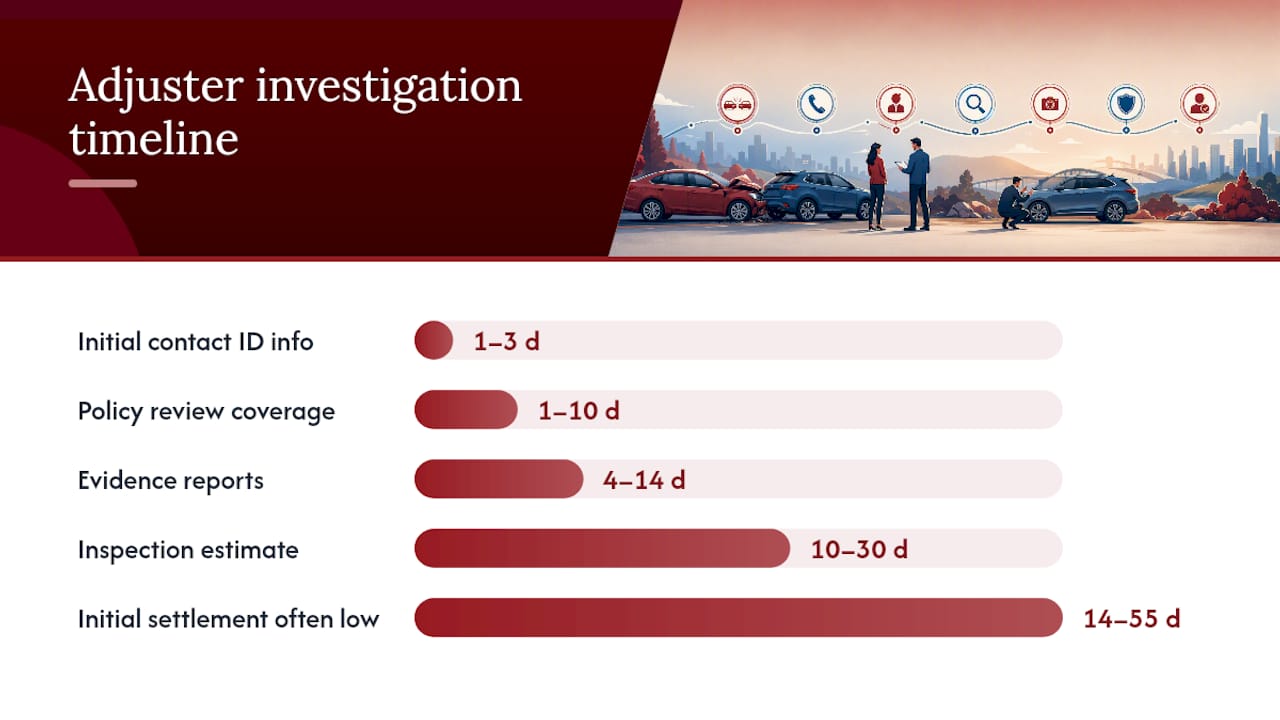
The investigation follows a predictable sequence, though timing varies by claim type and insurer. Most states require insurers to investigate claims within roughly 14 to 55 days and to provide written explanations for any delays. Knowing the expected pace helps you spot when an insurer is stalling.
| Stage | Typical Timeframe | What to Watch For |
|---|---|---|
| Initial contact | 1–3 days after filing | Adjuster identifies themselves and requests basic information |
| Policy review | Days 1–10 | Insurer confirms coverage, exclusions, and applicable limits |
| Evidence collection | Days 4–14 | Police report, photos, medical records, witness interviews |
| Inspection / estimate | Days 10–30 | Vehicle or property inspection; repair or replacement estimate prepared |
| Initial settlement offer | Days 14–55 | Written or verbal offer; often low and subject to negotiation |
Delays beyond 55 days without a written explanation are a signal worth acting on. When an investigation drags, ask the adjuster in writing for a status update and a projected timeline. If you get no response, that paper trail becomes the foundation for a state insurance department complaint.
Signs the investigation is moving too slowly:
- No written acknowledgment of your claim within 10 days.
- Inspection scheduled more than three weeks after filing.
- Repeated requests for documents you have already submitted.
- Verbal promises with no written follow-up.
Converting every verbal update into a dated email confirmation is the simplest way to hold the insurer to its own stated timelines.
What to say — and what to avoid — when talking to an adjuster
The words you choose in the first few calls can raise or lower your settlement by thousands of dollars. Bell Law Offices recommends staying calm and factual, getting the adjuster’s contact information, and preferring email for key exchanges. The goal is to give the adjuster only what they need to process the claim, nothing more.
Scripts that protect your claim:
First call:
Refusing a recorded statement (other party’s insurer):
Responding to a quick settlement offer:
| Say This | Avoid This |
|---|---|
| “I’m still treating; I’ll respond in writing.” | “I’m feeling better” or “It’s not that bad.” |
| “Please send that in writing.” | “I think it was partly my fault.” |
| “I’d like a written breakdown of that estimate.” | “I just want this over with.” |
| “My attorney/representative will be in touch.” | Casual remarks about your recovery timeline |
You have no legal obligation to give a recorded statement to the other party’s insurer. Progressive confirms that cooperation clauses in your own policy may apply with your own insurer, but even then, a blanket medical authorization can often be limited to relevant records, providers, and date ranges.
Pro Tip: After every phone call, send the adjuster an email within 24 hours: “Per our call today, you confirmed [X]. Please let me know if I’ve misunderstood anything.” That email becomes a contemporaneous record and discourages the adjuster from walking back verbal commitments.
Email beats phone for anything substantive. It creates a time-stamped record, removes ambiguity, and gives you time to think before responding.
The evidence that actually changes your settlement number
Documentation is not just paperwork. It is the mechanism by which your losses become undeniable. The more organized and specific your evidence, the harder it is for the adjuster to justify a low valuation.
Essential documents to collect:
- Police or incident report (request the official copy, not just the case number).
- All medical records related to the accident, including emergency room notes, specialist visits, and physical therapy.
- Itemized medical bills, not just totals.
- Pay stubs or employer letters documenting lost income.
- At least two independent repair or replacement estimates for property damage.
- Dated photos and videos of injuries, vehicle damage, and the accident scene.
- Witness names, phone numbers, and written statements where possible.
- Receipts for every out-of-pocket expense: transportation to appointments, medications, assistive devices.
For pain and suffering, a symptom journal carries real weight. Write a brief daily entry describing your pain level, what activities you could not do, and how the injury affected your work or family life. Dated medical progress notes from your treating physician complement this record and give the adjuster objective clinical language to work with.
When you present evidence, organize it into a single labeled PDF or a clearly tabbed physical folder. Group documents by category: medical, property, income, and other losses. An adjuster who can verify your numbers quickly has less reason to dispute them. A targeted medical records release limited to relevant providers, body parts, and date ranges also reduces the insurer’s ability to mine unrelated health history as a defense.
How to negotiate your settlement and push back on low offers
Settlement value has two components: economic damages (medical bills, future care costs, lost income, property damage) and non-economic damages (pain and suffering, emotional distress, loss of enjoyment). Adjusters routinely undervalue non-economic damages in the first offer because claimants rarely push back with documentation.
What adjusters deduct and how to counter each:
- Pre-existing conditions: They argue your injury predates the accident. Counter with dated medical records showing the accident caused a new injury or materially worsened an existing one.
- Comparative fault: They assign you partial blame to reduce the payout. Counter with the police report, witness statements, and photos that establish the other party’s fault.
- Excessive treatment: They claim some treatment was unnecessary. Counter with physician notes explaining the medical necessity of each visit.
- Speculative future costs: They discount future care estimates. Counter with a written opinion from your treating physician or a specialist.
The most effective negotiation tactic is to refuse the first offer and respond with a written, documented demand. LegalClarity’s negotiation guide recommends including a detailed incident description, injury summary, treatment timeline, itemized damages, and a response deadline, commonly 30 days.
Step-by-step negotiation sequence:
- Receive the initial offer in writing. Never accept verbally.
- Request a written breakdown of how the adjuster calculated the figure.
- Prepare a written counteroffer with your itemized damages and supporting documents attached.
- Set a 30-day response deadline in your letter.
- If the counter is still too low, ask to escalate to the adjuster’s supervisor in writing.
- State clearly that you are prepared to pursue additional options if a fair resolution is not reached.
Treat the negotiation as a business transaction. Emotional appeals rarely move adjusters; organized numbers do. Nolo’s injury claim guidance notes that adjusters use initial lowball offers to test how much a claimant knows and how urgently they need money. A calm, documented response signals that you are not a quick close.
What to do when the offer is still too low
If negotiation stalls, you have several escalation paths. Each has different costs, timelines, and likely outcomes.
Internal appeal and supervisor review:
- Write a formal letter to the adjuster’s supervisor summarizing the dispute, your documented damages, and the gap between the offer and your actual losses.
- Request a written response within 15 business days.
- Keep the tone professional; frame it as a request for reconsideration, not a threat.
State insurance department complaint:
- Every state has an insurance regulatory body. Filing a complaint puts the insurer on notice that a regulator is watching.
- Complaints are most effective when the insurer has missed investigation deadlines, failed to respond in writing, or acted in bad faith.
- The Texas Department of Insurance (TDI) and similar agencies in other states publish consumer complaint forms online and typically respond within 30–45 days.
Policy dispute mechanisms:
- Appraisal clause: Available in many property policies. Each side selects an appraiser; the two appraisers choose an umpire. Any two of the three agreeing on a value makes it binding. Each party pays their own appraiser; the umpire’s cost is shared.
- Mediation: A neutral third party facilitates negotiation. Non-binding but often resolves disputes faster than litigation.
- Arbitration: A neutral arbitrator hears both sides and issues a decision, which may be binding depending on the policy language.
When litigation makes sense:
- The insurer has acted in bad faith (unreasonable delays, misrepresentation, refusal to investigate).
- Your damages significantly exceed the offer and negotiation has failed.
- Liability is disputed and the evidence strongly supports your position.
Escalation affects timing. Filing a complaint or initiating appraisal typically adds weeks to months. Litigation adds more. Weigh that against the gap between the offer and your documented losses.
When should you hire a lawyer or a public adjuster?
Some situations call for professional representation from the start. Others become clear only after negotiation stalls.
Hire a personal injury attorney when:
- The settlement offer is significantly below your documented damages.
- You suffered serious injuries, permanent disability, or long-term treatment needs.
- Liability is disputed or multiple parties are involved.
- The insurer is delaying, ignoring your communications, or acting in bad faith.
- The claim approaches or exceeds the at-fault party’s policy limits.
- You receive a release with “known and unknown” waiver language. Alllaw warns that signing such a release typically bars any future claims related to the incident.
Hire a public adjuster when:
- Your dispute is a first-party property claim (homeowner’s, commercial property).
- You believe the insurer’s damage estimate is too low but liability is not contested.
- The claim involves complex structural damage or business interruption losses.
Personal injury attorneys typically work on contingency, meaning no upfront cost and a percentage of the recovery, commonly one-third. Both arrangements align the professional’s incentive with yours.
Pro Tip: Once you have representation, use this script with the adjuster: “All further communications regarding my claim should go through my representative, [Name], at [contact information]. Please do not contact me directly.” Send it in writing and keep a copy.

Ready-to-use scripts and your claim-prep checklist
Phone scripts:
First call with the adjuster:
Refusing a recorded statement:
Responding to a quick settlement offer:
Email templates:
Confirming a phone conversation:
Requesting a written estimate breakdown:
Sending a demand counteroffer:
Claim-prep checklist by stage:
Immediately after the accident:
- [ ] Photograph the scene, vehicles, injuries, and road conditions.
- [ ] Get the police report number and request the official copy.
- [ ] Collect witness names and contact information.
- [ ] Seek medical attention and keep all records.
Within 1–30 days:
- [ ] Open a claim folder (physical or digital).
- [ ] Log every adjuster contact: date, time, name, and summary.
- [ ] Obtain at least two independent repair or replacement estimates.
- [ ] Gather pay stubs or employer documentation for lost income.
- [ ] Start a daily symptom journal.
Ongoing:
- [ ] Follow up every phone call with a confirmation email within 24 hours.
- [ ] Track all out-of-pocket expenses with receipts.
- [ ] Update your symptom journal after every medical appointment.
- [ ] Review any release language with an attorney before signing.
The settlement process guide from Carcrashmoneyatl walks through each stage in detail if you want a deeper look at what to expect as your claim progresses.
What most guides get wrong about dealing with adjusters
The standard advice, “stay calm and document everything,” is correct but incomplete. What it misses is the timing problem. Most claimants lose ground not because they say the wrong thing, but because they respond too soon. They accept an offer before treatment ends, sign a release before understanding its scope, or give a recorded statement before they have organized their own account of events.
The adjuster’s job is to close the file. Yours is to keep it open until you know what you are actually owed. Those two goals are in direct tension, and the adjuster has more practice navigating that tension than you do. The claimants who recover the most are not the ones who argue the hardest; they are the ones who wait the longest with the best documentation.
There is also a common misconception that hiring an attorney signals aggression or escalation. In practice, it often accelerates resolution. Insurers know that represented claimants are more likely to pursue litigation, which costs the insurer more than a fair settlement. A well-timed referral to a vetted personal injury attorney is frequently the single action that moves a stalled claim forward.
The emotional weight of an accident is real, and adjusters are trained to use urgency and sympathy to close claims quickly. Recognizing that dynamic, and responding with patience and paperwork, is the most underrated skill in this entire process.
How Carcrashmoneyatl connects accident victims with the right help
Navigating an insurance claim alone is manageable with the right preparation. But when the offer is too low, the investigation stalls, or the paperwork becomes overwhelming, having a vetted attorney in your corner changes the outcome.

Carcrashmoneyatl connects car accident victims in the Atlanta area with experienced personal injury attorneys and trusted medical providers at no direct cost to you. The referral process is straightforward: share your situation, and the team evaluates your needs to match you with the right professional, whether that is a policy-limit specialist, a medical provider who understands injury documentation, or a personal injury attorney ready to take on the insurer. There are no upfront fees for victims, and the attorneys in the network work on contingency. If you are unsure whether your claim warrants legal help, a case evaluation through Carcrashmoneyatl’s services is a low-friction way to find out. Reach out today and let a vetted professional review where your claim stands.
Sources
These sources provide official and authoritative guidance you can reference in appeals, supervisor requests, and regulatory complaints.
- Insurance adjusters: who they are and how they handle injury claims — Nolo
- Tips for the first call with an adjuster after an accident — Alllaw
- How to negotiate with an insurance adjuster: step by step — LegalClarity
- What is an insurance adjuster? — Progressive
- How to deal with insurance adjusters: expert tips to win your claim — Bell Law Offices
This article provides general information about interacting with insurance adjusters and is not a substitute for legal advice. Claim rules, timelines, and legal obligations vary by state and policy. Consult a licensed personal injury attorney in your jurisdiction before making decisions about your specific claim.
Recommended
- Georgia Car Accident Injury Claim Advice: The 2026 Victim’s Recovery Guide – Car Crash Money Atlanta
- Car Accident Settlement Process Georgia: The 2026 Victim’s Guide – Car Crash Money Atlanta
- Car Accident Policy Limit Specialist: How to Break the Insurance Ceiling in Atlanta (2026) – Car Crash Money Atlanta
- Our Blog – Car Crash Money Atlanta