
If you were hurt in a Georgia car accident, you generally have two years from the date of the crash to file a personal injury lawsuit. This deadline comes directly from O.C.G.A. § 9-3-33, Georgia’s controlling statute of limitations for injury claims, which states that actions for injuries to the person must be brought within two years after the right of action accrues.
That two-year window is the rule most car accident victims need to know, but it isn’t the whole story. Georgia law carves out different deadlines depending on what you’re claiming and who caused the crash.
- Wrongful death claims generally run a limited time from the date of death, not the date of the crash, which can push the deadline later than you’d expect.
- Property damage claims (your vehicle repairs, for instance) get a longer window under Georgia law.
- Claims against a government entity (a city bus, county vehicle, or state trooper) often carry shorter notice deadlines than the standard two years, sometimes measured in months to about a year.
“Actions for injuries to the person shall be brought within two years after the right of action accrues,” reads the core text of O.C.G.A. § 9-3-33, the statute that governs nearly every Georgia car accident injury claim.
We built Carcrashmoneyatl to help you act fast on exactly this kind of deadline, and understanding these rules now, while you still have time to act, puts you in control of your case instead of at the mercy of an insurance adjuster’s clock.
Key Takeaways
Georgia law gives most car accident injury victims exactly two years from the crash date to file suit under O.C.G.A. § 9-3-33, with sharply shorter deadlines for government-entity claims.
| Point | Details |
|---|---|
| Two-year injury deadline | Most Georgia personal injury lawsuits must be filed within two years of the accident date under O.C.G.A. § 9-3-33. |
| Property damage gets four years | Vehicle and property damage claims run on a separate four-year statute, longer than injury claims. |
| Wrongful death starts at death | The two-year wrongful death clock begins on the date of death, which may be well after the crash date. |
| Government claims move fast | Claims against cities, counties, or the state can require notice in as little as six months to one year. |
| Preserve evidence immediately | Medical care, police reports, and photos in the first 72 hours protect both your claim and your deadline. |
| Get matched with help quickly | Carcrashmoneyatl connects injured Georgians to attorneys and medical providers fast, before deadlines close in. |
Table of Contents
- What the Georgia Statute of Limitations for Car Accidents Actually Says
- When Does the Clock Start Running on Your Georgia Injury Claim?
- Related Deadlines You Need to Track Besides the Two-Year Rule
- Your Insurer’s Deadline Is Not the Same as the Legal Filing Deadline
- What Happens If You Miss Georgia’s Filing Deadline
- How to Calculate Your Exact Filing Deadline
- What to Do Right Now to Protect Your Georgia Injury Claim
- When to Contact a Georgia Car Accident Attorney
- Get Help Preserving Your Georgia Car Accident Claim Before Time Runs Out
- Frequently Asked Questions About Georgia’s Car Accident Deadline
- Sources
What the Georgia Statute of Limitations for Car Accidents Actually Says
The Georgia personal injury statute of limitations isn’t a policy or a guideline. It’s binding law, written in plain terms, that courts apply almost mechanically once the deadline passes.
§ 9-3-33 states: “Actions for injuries to the person shall be brought within two years after the right of action accrues, except for injuries to the reputation, which shall be brought within one year after the right of action accrues, and except for actions for injuries to the person involving loss of consortium, which shall be brought within four years after the right of action accrues.”
That single sentence, hosted in full by Casetext’s Georgia Code database, controls the vast majority of Georgia car accident injury claims. Broken auto crashes fall squarely under “injuries to the person,” meaning:
- Broken bones, whiplash, traumatic brain injury, and other physical harm from a crash: a limited time period defined by law.
- Injuries to reputation, a narrower category rarely relevant to car accidents: a limited time period defined by law.
- Loss of consortium, a spouse’s claim for loss of companionship or support due to a partner’s injury: a longer period than injury claims, defined by law.
Notice that loss of consortium gets double the time of the underlying injury claim. That mismatch trips up families constantly. A husband might miss his own personal injury window while his wife’s consortium claim is still technically alive, but without the injury claim behind it, the consortium claim usually collapses too.
Why does linking directly to the official code matter so much? Because law firm blogs and legal summary sites paraphrase statutes constantly, and paraphrasing introduces error. When you or your attorney need to confirm a filing deadline down to the exact day, the official Georgia Code text is the only version that matters in court.
When Does the Clock Start Running on Your Georgia Injury Claim?
For most car accident cases, the two-year clock starts on the date of the crash itself. Georgia courts call this the “accrual date,” and for a straightforward rear-end collision or intersection crash, accrual happens the moment the impact occurs and injury results.
But Georgia recognizes several situations where the clock pauses, delays, or extends. Lawyers call this “tolling,” a legal term Cornell Law School’s Legal Information Institute defines simply as suspending or delaying the running of a statutory time limit until some condition changes.
Common tolling and extension situations in Georgia car accident cases include:
- Minors. If the injured person was under 18 at the time of the crash, the statute typically doesn’t start running until they turn 18, giving them until their 20th birthday in most cases.
- Legal incapacity. Someone who is mentally incompetent at the time of injury may get extra time until their capacity is restored.
- Defendant absent from Georgia. If the at-fault driver leaves the state, the time they’re gone generally doesn’t count against your filing window.
- Fraudulent concealment. If a defendant actively hides facts that would let you discover your claim, courts may delay accrual until you reasonably should have discovered it.
- Criminal prosecution tolling. According to a Georgia-focused legal guide, if the driver who hit you faces criminal charges from the same crash (DUI, reckless driving), the statute of limitations can toll while that prosecution is pending, subject to statutory caps.
- Government defendants. Claims against public entities follow entirely separate, shorter notice rules discussed below, not the standard tolling framework.
Georgia courts interpret these exceptions narrowly. A driver who simply “didn’t realize how bad the injury was” until months later usually doesn’t get a discovery-rule extension, because the crash itself was an obvious, discoverable event on day one. Discovery rules in Georgia mostly protect situations where the injury or its cause genuinely couldn’t have been known, not situations where someone waited too long to see a doctor.
Pro Tip: Don’t assume you qualify for a tolling exception just because your situation feels unusual. Georgia courts have dismissed cases where plaintiffs guessed wrong about tolling rules and filed too late to fix the mistake. Get a lawyer to confirm which exceptions actually apply to your facts before you rely on one.
Related Deadlines You Need to Track Besides the Two-Year Rule
The two-year personal injury clock gets the most attention, but a single car accident often creates several claims running on different timelines. Missing one because you assumed a single deadline covered everything is a common, costly mistake.
| Claim Type | Georgia Deadline | Clock Starts |
|---|---|---|
| Personal injury (physical harm) | 2 years | Date of the accident |
| Wrongful death | 2 years | Date of death (not date of crash) |
| Property damage (vehicle, belongings) | 4 years | Date of the accident |
| Loss of consortium | 4 years | Date of the accident |
| Injury to reputation | 1 year | Date the reputational harm occurs |
| Claims against Georgia government entities | As short as 6 months to 1 year for notice | Date of the accident |
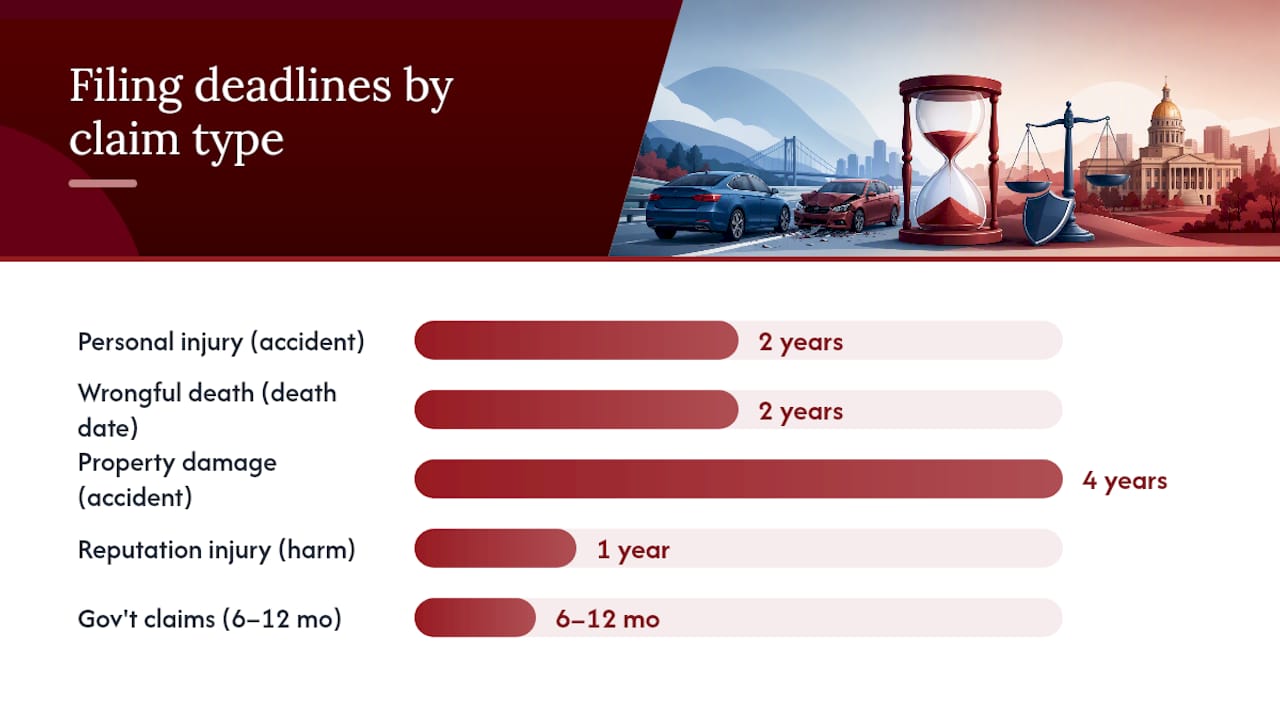
Wrongful death deserves special attention. If a loved one survives the crash for weeks or months before passing away, the two-year wrongful death clock runs from the date they died, not the date of the collision. Families sometimes calculate their deadline from the wrong date entirely, thinking they have less time than they actually do, or worse, more time than they actually do.
Property damage claims get a notably longer four-year window, according to FindLaw’s summary of Georgia’s civil limitations laws. That means a dispute over vehicle repair costs can sometimes still be pursued years after your personal injury claim would already be barred.
Government-entity claims are the trap that catches the most people off guard. If a county vehicle, city bus, MARTA train, or state trooper caused your crash, you’re dealing with the Georgia Tort Claims Act and often a local ante litem notice requirement measured in months, not years. These shortened windows exist specifically to give public entities early warning, and missing them can bar your claim before the standard two-year period even becomes relevant. If a government vehicle was involved in your crash, treat that notice deadline as your real emergency, not the two-year rule.
Your Insurer’s Deadline Is Not the Same as the Legal Filing Deadline
One of the most common and costly misunderstandings in Georgia car accident claims is confusing your insurance company’s reporting deadline with the two-year statute of limitations. These are two completely separate obligations, and satisfying one does nothing to satisfy the other.
Your auto policy almost certainly requires “prompt notice” of an accident, language that typically means days to a few weeks, not years. Miss that window and your own insurer can deny coverage on procedural grounds, regardless of how much time you have left to sue the other driver. A consumer legal guide on Georgia accident deadlines makes this distinction clearly: reporting promptly to your carrier protects your policy benefits, while the statute of limitations protects your right to sue in court. They run on entirely different clocks, and treating them as interchangeable is how people accidentally forfeit coverage they never needed to lose.
Hit-and-run cases add another layer. If the at-fault driver fled the scene, reporting to police immediately does double duty: it creates the official record you’ll need for a possible uninsured motorist claim, and it starts the evidence-preservation clock before memories fade and traffic camera footage gets overwritten.
Immediate steps that protect both your insurance coverage and your legal deadline:
- Notify your insurer within days of the crash, even if fault is still unclear.
- Get medical care immediately and keep every record, since gaps in treatment history get used against you later.
- Request a copy of the official police report as soon as it’s available.
- Photograph the scene, vehicle damage, and any visible injuries before repairs or healing change the picture.
Pro Tip: Save every insurance communication in writing, including claim reference numbers, adjuster names, and dates of calls. If your case eventually turns on when you “knew” about an injury or a denial, that paper trail becomes evidence in itself.
What Happens If You Miss Georgia’s Filing Deadline
Missing the statute of limitations in Georgia almost always means your case is over before it starts. Once the two-year window closes, the at-fault driver’s insurance company or attorney can raise a statute-of-limitations defense, and Georgia courts routinely dismiss cases on exactly that basis, regardless of how strong the underlying injury claim might have been.
Courts treat the statute of limitations as a firm procedural bar, not a suggestion. As legal reference guides on Georgia’s personal injury deadlines note, missing the filing period generally means dismissal, no matter how clear liability or how severe the injuries.
There are narrow, rarely successful exceptions:
- Equitable tolling in genuinely extraordinary circumstances, applied sparingly and inconsistently by courts.
- Fraud-based discovery delay, where a defendant actively concealed the basis for your claim.
- Statutory exceptions already discussed, like the defendant’s absence from Georgia or the plaintiff’s minority status at the time of injury.
None of these are a backup plan. Betting your case on convincing a judge that an exception applies, after the deadline has already passed, is a losing strategy far more often than it succeeds. If you’re unsure whether your deadline has already passed or is approaching fast, talk to a Georgia attorney immediately rather than guessing your way through a tolling argument.
How to Calculate Your Exact Filing Deadline
Calculating your personal deadline isn’t complicated once you know the four steps, but getting the accrual date wrong by even a few days can matter in a close case.
- Identify your accrual date. For most injury claims, this is the exact date of the crash. For wrongful death, it’s the date of death.
- Add the statutory period. Two years for personal injury and wrongful death, four years for property damage and loss of consortium.
- Account for any tolling. Subtract time the defendant was out of state, add time for a plaintiff’s minority, or adjust for pending criminal prosecution tolling, whichever applies to your facts.
- Confirm the exact calendar date and check for weekends or holidays. If your deadline lands on a weekend or state holiday, Georgia practice generally extends filing to the next business day, but confirm this with your attorney rather than assuming it.
Example 1: Standard injury claim. A crash occurs on March 12, 2026. With no tolling, the personal injury lawsuit must be filed by March 12, 2028.
Example 2: Wrongful death claim. A crash occurs on March 12, 2026, but the victim survives in the hospital until June 20, 2026, before passing away. The wrongful death clock starts June 20, 2026, meaning the family has until June 20, 2028, two years from the date of death, not the date of the crash.
Filing on the last permissible day is legally valid in Georgia as long as the complaint reaches the courthouse before it closes, but no attorney wants to test that margin. Building in a buffer of weeks, not days, gives your legal team room to fix filing errors, gather final records, or respond to unexpected complications.
What to Do Right Now to Protect Your Georgia Injury Claim
The steps you take in the first 72 hours after a crash often determine whether a strong claim stays strong or quietly falls apart before you even talk to a lawyer.
In the first 24 to 72 hours, prioritize:
- Getting emergency medical care immediately, even if injuries feel minor at first.
- Calling police to the scene and making sure an official report gets filed.
- Collecting contact and insurance information from every driver involved.
- Photographing the scene, vehicle damage, road conditions, and visible injuries.
- Getting names and phone numbers from any witnesses before they leave.
In the following days and weeks:
- Keep every medical record, bill, and follow-up appointment note in one place.
- Track lost wages and out-of-pocket expenses as they happen, not from memory later.
- Save all written communication with insurance adjusters.
- Avoid giving a recorded statement to any insurance company without talking to an attorney first.
Pro Tip: Preserve digital evidence too. Dash camera footage, phone photos with timestamps, and even your own social media posts about the crash can all become evidence later. Back up dash cam files immediately, since many devices overwrite old footage automatically within days. Carcrashmoneyatl connects injured Georgians with medical providers and personal injury attorneys quickly, which matters most in this early window when evidence is disappearing and deadlines are already running.
When to Contact a Georgia Car Accident Attorney
Contact an attorney promptly after a Georgia car accident, not after you’ve already tried to handle the insurance company alone for months. Waiting rarely helps your case and often hurts it, since evidence fades and insurers use delay to their advantage.
Clear signs you should call a lawyer now rather than later:
- Your injuries are serious, involve surgery, or require ongoing treatment.
- Fault is disputed or unclear between drivers.
- Symptoms appeared or worsened days after the crash.
- The at-fault driver was uninsured or underinsured.
- A loved one died in the crash.
- A government vehicle or employee was involved, triggering short notice deadlines.
Bring these items to your first consultation:
- The official police report, or the report number if it isn’t ready yet.
- Medical records and bills from every provider you’ve seen since the crash.
- Photos of the scene, vehicle damage, and injuries.
- Insurance information for every driver involved, including your own policy.
- Names and contact information for any witnesses.
- A written timeline of the crash date, treatment dates, and any communication with insurers.
Questions worth asking during that first call: How is your fee structured, and does it come out of any settlement? What is the realistic timeline for a case like mine? Are there any government-notice deadlines in my case that need to be filed sooner than the standard two years? Do you need to send any preservation letters or file anything immediately to protect evidence?
A referral network’s view on the mistakes that cost victims the most
The patterns repeat across nearly every Georgia crash case that comes through a referral network like ours: someone waits weeks to see a doctor because the pain seemed manageable, someone assumes their insurer’s claim number means their legal deadline is also handled, or someone doesn’t realize a city vehicle was involved until the ante litem notice period has already closed. None of these are unusual people making obviously bad decisions. They’re ordinary people dealing with pain, paperwork, and a legal system that doesn’t pause for either.

What tends to separate a preserved claim from a lost one isn’t luck. It’s speed in the first two weeks: getting treatment on record, getting the police report secured, and getting a professional looking at the deadlines before assumptions calcify into missed windows. Carcrashmoneyatl exists to close that gap fast, connecting injured Georgians to attorneys and medical providers who already know these deadlines cold.
Get Help Preserving Your Georgia Car Accident Claim Before Time Runs Out
Georgia’s two-year statute of limitations doesn’t wait for you to feel ready, and every week spent unsure about deadlines, government-notice rules, or which attorney to call is a week you can’t get back. Carcrashmoneyatl gives you a faster path than sorting through firms alone: one referral request connects you directly to vetted personal injury attorneys and medical providers who already handle Georgia crash cases and know exactly how these deadlines apply to your situation.

Instead of researching law firms for weeks while your filing window quietly shrinks, you get matched with legal and medical partners suited to your specific injuries and circumstances, often within days. That matters most for government-vehicle cases, wrongful death claims, or any situation where a shortened notice period could bar your claim long before the standard two years expires. Visit Carcrashmoneyatl’s services page to start your free case evaluation now, or explore the Atlanta professional network to see how referrals work before you commit to anything.
Frequently Asked Questions About Georgia’s Car Accident Deadline
What is the statute of limitations for a car accident in Georgia?
Georgia’s statute of limitations for car accident injury claims is two years from the date of the crash, under O.C.G.A. § 9-3-33. Property damage claims get four years, and wrongful death claims run two years from the date of death.
Does the Georgia statute of limitations ever get extended?
Yes, in specific situations. Georgia law can toll or extend the deadline for minors, legally incapacitated individuals, cases where the defendant left the state, fraudulent concealment, and sometimes while a related criminal prosecution is pending.
What happens if I miss the filing deadline in Georgia?
Your case will almost certainly be dismissed if you miss Georgia’s statute of limitations. Courts treat the deadline as a firm procedural bar, and exceptions are rare and narrowly applied.
Is the deadline different if a government vehicle hit me?
Yes. Claims against Georgia government entities often require formal notice within six months to one year, far shorter than the standard two-year personal injury deadline, under the Georgia Tort Claims Act framework.
Does reporting to my insurance company satisfy the statute of limitations?
No. Insurance reporting deadlines and Georgia’s civil statute of limitations are completely separate obligations. Reporting promptly to your insurer protects your policy coverage, but only filing a lawsuit within two years protects your legal right to sue.
When should I contact a lawyer about my Georgia car accident claim?
Contact a Georgia attorney as soon as possible after your crash, especially if injuries are serious, fault is disputed, a government vehicle was involved, or a loved one died. Waiting reduces your options and risks losing time you can’t recover.
This article is general information, not a substitute for advice from a qualified lawyer. Consult a qualified legal professional about your own circumstances before acting on anything here.
Sources
Confirming these deadlines against primary legal sources, rather than relying on any single summary, protects you from outdated or oversimplified information.
- 2020 Georgia CodeTitle 9 – Civil PracticeChapter 3 – Limitations of ActionsArticle 2 – Specific Periods of Limitation§ 9-3-33. Injuries to the Person; Injuries to Reputation; Loss of Consortium; Exception
- Georgia civil statute of limitations laws (FindLaw)
- Toll (Cornell LII)
Recommended
- Georgia Car Accident Injury Claim Advice: The 2026 Victim’s Recovery Guide – Car Crash Money Atlanta
- Car Accident Settlement Process Georgia: The 2026 Victim’s Guide – Car Crash Money Atlanta
- Our Blog – Car Crash Money Atlanta
- Car Accident Policy Limit Specialist: How to Break the Insurance Ceiling in Atlanta (2026) – Car Crash Money Atlanta