
An evidence preservation letter is a formal written notice demanding that another party safeguard specific documents, data, and physical items connected to an anticipated lawsuit. It is not a subpoena and does not force immediate production, but it does something equally powerful: it creates a legal record showing the recipient knew litigation was coming. If they destroy evidence after receiving it, courts can impose serious sanctions.
Your first move after a Georgia crash is to send a targeted preservation demand to the at-fault driver, their insurer, and any business that controls surveillance footage or vehicle data. Do it before anything else, because some of the most valuable evidence disappears quickly.
Send your initial preservation notice as soon as possible after the crash, covering at minimum:
- Surveillance and dashcam footage (many systems overwrite within 24–72 hours)
- Event Data Recorder (EDR/black box) data from the at-fault vehicle
- Cell phone records and text messages from the at-fault driver
- Any telematics or GPS data from commercial vehicles
Delivery checklist: Send via certified mail with return receipt requested AND email the same letter as a PDF. Save the certified-mail tracking number, the emailed timestamp, and a copy of the sent PDF. Keep everything in one folder. That paper trail is what defeats a later claim of “I never received it.”
One critical caution: sending a preservation letter does not pause your statute of limitations or any administrative notice deadline. Georgia law includes a general personal-injury statute of limitations, and that clock keeps running regardless of any preservation notice you send.
Key Takeaways
A timely, specific evidence preservation letter sent within 24–72 hours of a Georgia crash is the single most effective step you can take to protect fragile evidence and preserve your legal claim.
| Point | Details |
|---|---|
| Send within 24–72 hours | Surveillance and EDR data overwrite fast; a same-day email demand buys critical time. |
| Specificity is legally required | Name custodians, systems, and date ranges — vague demands give courts little to work with on spoliation. |
| Use two delivery methods | Certified mail plus emailed PDF creates a documented record that defeats “I never received it” defenses. |
| Preserve your own evidence | Do not reset your phone, delete texts, or alter any records; your duty to preserve runs both ways. |
| Carcrashmoneyatl speeds attorney access | The referral network connects Georgia victims with personal-injury attorneys who can send preservation demands the same day. |
Table of Contents
- What an evidence preservation letter actually does in Georgia
- When to send a preservation letter and why timing is everything
- Who should receive the preservation letter
- What to include in the letter — language courts take seriously
- Types of evidence to request — don’t leave these off the list
- How to demand preservation of electronic data
- How to send the letter and document receipt
- What courts can do when evidence is destroyed
- Immediate checklist and 48–72 hour timeline
- Two sample letters you can adapt
- When to contact an attorney and what happens next
- The mistake most victims make — and what actually changes outcomes
- How Carcrashmoneyatl connects you to Georgia attorneys who act fast
- Sources
What an evidence preservation letter actually does in Georgia
A preservation demand formally notifies an opposing party that they must safeguard documents, electronic data, and physical items connected to a potential lawsuit. The duty to preserve arises the moment litigation becomes “reasonably foreseeable,” which in Georgia crash cases typically means the moment a serious injury occurs, a demand letter goes out, or a victim consults an attorney.
The letter itself does not compel production. You are not asking for the evidence right now; you are putting the recipient on notice that destroying it would be a serious legal problem. That distinction matters because it shapes how you write the letter and what remedies become available if evidence later goes missing.
Georgia state courts and federal courts handle spoliation differently, and your forum matters. Federal courts apply Federal Rule of Civil Procedure 37(e), which requires a finding of intent to deprive before courts can give an adverse inference instruction. Georgia state courts apply a broader common-law spoliation doctrine that gives judges more discretion to impose sanctions even without proof of bad faith. If your case is in Fulton County Superior Court rather than the Northern District of Georgia, that difference can work in your favor.
When to send a preservation letter and why timing is everything
The trigger is simple: the moment you reasonably anticipate litigation, the duty to preserve attaches. For accident victims, that moment usually arrives at one of three points: the crash itself causes serious injury, you consult an attorney, or you send a demand to an insurer. Do not wait for a lawsuit to be filed.
Here is why timing is so unforgiving for crash evidence:
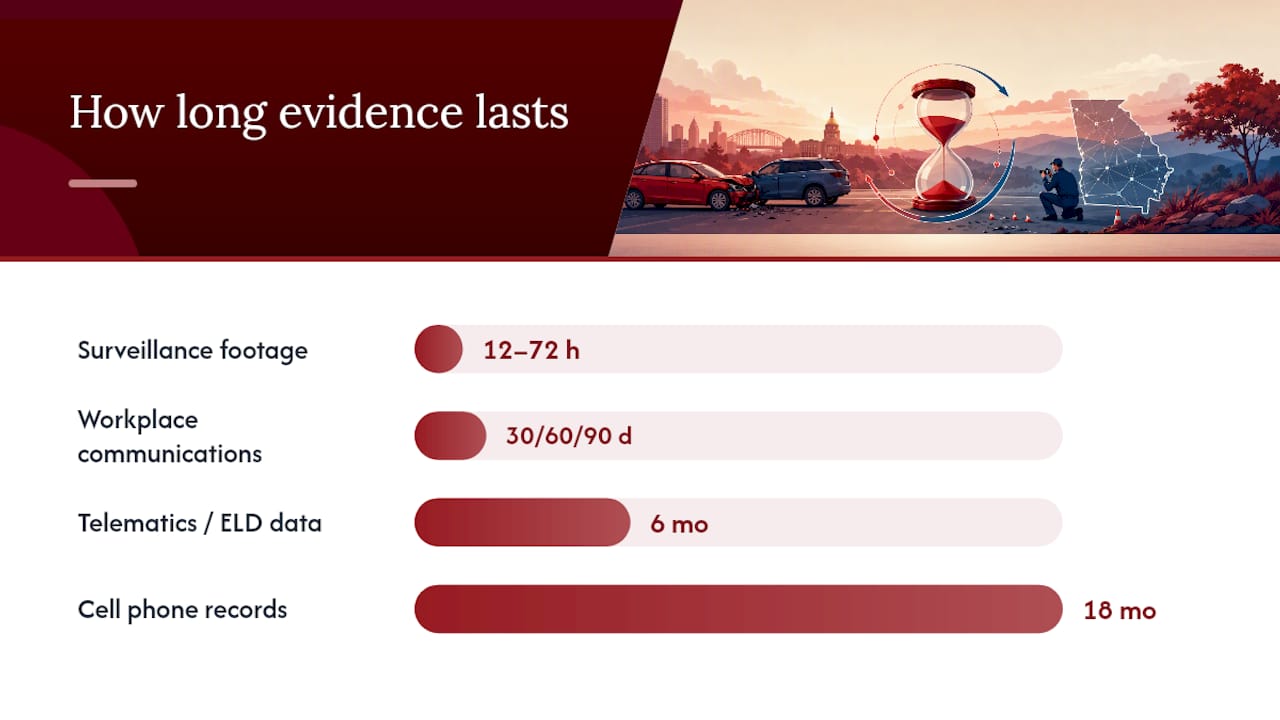
- Surveillance footage from businesses, traffic cameras, and parking lots typically overwrites on a 24–72 hour cycle. Some systems run as short as 12 hours. Once overwritten, that footage is gone permanently.
- EDR (black box) data can be overwritten if the vehicle is driven again after the crash, especially if the airbags did not deploy. A second collision or even a hard brake event can overwrite the pre-crash data.
- Dashcam footage on loop-recording devices overwrites continuously. Without a manual save or power interruption, the crash footage may be gone within hours.
- Cell phone records at the carrier level are typically retained for 18 months, but text message content retention varies by carrier and can be much shorter.
- Telematics and ELD data from commercial trucks are often retained for only 6 months under federal minimum standards, and some carriers purge sooner.
- Workplace communications (Slack, Teams, email) may be subject to auto-delete policies that run on 30, 60, or 90-day cycles unless suspended.
Delays cost real money. A victim who waits two weeks to send a preservation demand after a commercial truck crash may find that the ELD data covering the driver’s hours of service has already been purged. That data could have shown fatigue or a federal hours-of-service violation. Without it, the case becomes significantly harder to prove, and settlement leverage drops accordingly. The Georgia-specific guidance from Dressie Law Firm reinforces this point: placing insurers and defendants on notice early is one of the most consequential steps a crash victim can take.
Who should receive the preservation letter
Getting the right letter to the right person is as important as writing it correctly. A letter addressed to the wrong department or a general P.O. box may not reach someone with authority to suspend deletion policies.
For a typical Georgia car crash, send to:
- The at-fault driver personally (home address if known)
- The vehicle owner if different from the driver (a fleet owner, employer, or rental company)
- The at-fault driver’s insurer (claims department and, if known, their assigned adjuster)
- Any business that owns or controls surveillance cameras covering the crash scene
- Third-party telematics or dashcam vendors if the vehicle used a fleet management system
For businesses and corporate defendants, address to:
- General Counsel or Legal Department (by name if available)
- Risk Manager or Claims Manager
- Records Custodian or IT Director (for ESI-specific demands)
- If the business already has defense counsel, send directly to that attorney
If a third party controls evidence but is not a party to the anticipated lawsuit, such as a gas station whose camera captured the crash, you can still send a voluntary preservation request. Frame it as a request rather than a demand, explain that litigation is anticipated, and ask them to preserve the footage pending a formal subpoena. Most businesses will comply when they understand the request is coming from a potential litigant.
What to include in the letter — language courts take seriously
Courts evaluate specificity when deciding whether a preservation letter was meaningful. A vague letter that says “preserve all documents related to the accident” carries far less weight than one that names specific custodians, systems, and date ranges. Naming specific custodians, systems, and date ranges maximizes the letter’s force in any later spoliation dispute.
Every preservation letter should include:
- Sender identification: Your full name, address, and your relationship to the incident (injured party, representative, or counsel)
- Incident description: Date, time, and precise location of the crash; vehicle descriptions and license plates if known
- Litigation statement: An unambiguous sentence stating that you anticipate filing a civil claim arising from the incident
- Specific preservation demands: Named categories of evidence, named custodians, and explicit date ranges
- ESI instructions: A directive to suspend auto-delete policies, preserve backups, and maintain native file formats with metadata intact
- Response request: Ask the recipient to confirm receipt and confirm that preservation steps have been taken
The litigation statement is the most legally critical sentence in the letter. Courts look for language that makes litigation “reasonably foreseeable” without ambiguity. Phrases that work: “Please be advised that [your name] anticipates filing a civil action arising from the above-described incident and demands that you immediately preserve all evidence described herein.” Phrases that undermine the letter: vague references to “potential issues” or “concerns about the accident” without explicitly naming anticipated litigation.
Pro Tip: Avoid catch-all phrases like “any and all documents” as the only description. Courts treat overbroad demands skeptically, and a recipient can argue they did not know what specifically to preserve. Name the systems, the custodians, and the date range. Specificity is your protection.
Types of evidence to request — don’t leave these off the list
Georgia crash cases involve a wider range of evidence than most victims realize. Missing a category in the initial letter can mean losing it permanently.
Physical evidence:
- The at-fault vehicle (do not allow repair or disposal before inspection)
- Skid marks, debris fields, and road conditions (photograph immediately; these disappear quickly)
- Traffic control devices and their condition at the time of the crash
- Any physical objects involved (cargo, equipment, load-securing hardware)
Surveillance and video:
- Business security cameras within a reasonable radius of the crash scene
- Traffic and intersection cameras (GDOT and local DOT systems)
- Dashcam footage from the at-fault vehicle and any nearby vehicles
- Body camera footage from responding law enforcement (subject to Georgia Open Records Act requests)
Electronic and vehicle-specific data:
- EDR/black box data (pre-crash speed, braking, steering input, seatbelt status)
- ELD/telematics data for commercial vehicles (location, speed, hours of service)
- GPS navigation history from the at-fault driver’s phone or vehicle system
- Cell phone records, call logs, and text messages (especially relevant for distracted-driving claims)
ESI and workplace records:
- Email and internal communications related to vehicle maintenance, driver assignments, or safety policies
- Slack, Teams, or other workplace chat logs
- Driver qualification files and training records for commercial drivers
- Maintenance logs, inspection reports, and repair records for the at-fault vehicle
Medical and personnel records:
- The at-fault driver’s drug and alcohol test results if a commercial vehicle was involved
- Prior accident history and driving record
- Your own medical records from the date of the crash forward (preserve these on your end)
Surveillance footage and vehicle telematics are consistently the highest-priority items because their retention windows are the shortest. Request those first, even in a preliminary email, before the full letter arrives by certified mail.
How to demand preservation of electronic data
Electronic evidence requires specific instructions that go beyond “preserve your records.” Without explicit ESI demands, a recipient may argue that their routine deletion policy was already running and they had no reason to suspend it.
Include these specific ESI instructions in your letter:
- Suspend all automatic deletion, overwrite, or archiving policies for any system that may contain relevant data
- Preserve all backup tapes, cloud backups, and archived copies in their current state
- Maintain all electronic files in native format with metadata intact (do not convert to PDF or print-to-file)
- Identify and notify all custodians who may have relevant data on personal devices, work devices, or cloud accounts
- Preserve data from specific named platforms: email (including deleted items and sent folders), text messages, Slack, Microsoft Teams, WhatsApp, and any fleet management or telematics platform
A sample ESI paragraph you can adapt:
“You are hereby directed to immediately suspend any automatic deletion, overwrite, or purge policies applicable to electronically stored information (ESI) that may be relevant to the above-described incident. This includes, but is not limited to, email accounts, text messages, voicemail, GPS and telematics systems, dashcam storage, EDR data, and any cloud-based storage or backup systems. All such ESI must be preserved in native format with all metadata intact. Please identify and notify all individuals (custodians) who may possess relevant ESI and instruct them to preserve it immediately.”
Chain of custody matters from the moment preservation begins. Litigation-hold best practices call for documenting who preserved what, when, and how. Native format with metadata is critical for admissibility because metadata shows when a file was created, modified, and accessed. A printed copy of an email, for example, loses the header data that proves it was sent at a specific time from a specific server.

How to send the letter and document receipt
The best-written preservation letter is useless if you cannot prove the recipient got it. Courts have dismissed spoliation arguments when the moving party could not show the opposing party actually received notice.
Send every preservation letter by two methods simultaneously. First, certified mail with return receipt requested through the U.S. Postal Service. The green return-receipt card, once signed and returned, is your proof of delivery with a date stamp. Second, email the same letter as a PDF attachment to every known email address for the recipient, including the claims adjuster, the company’s legal department, and defense counsel if known. The email timestamp in your sent folder is a second layer of proof.
Keep a delivery log for each letter sent. Record the recipient’s name and address, the date and method of sending, the certified-mail tracking number, the email addresses used, and the date you received the return receipt. Screenshot the email’s sent confirmation and save it alongside the PDF. If you use a legal document delivery service, save the confirmation receipt.
Follow up in writing if you do not receive an acknowledgment within five business days. A short email asking the recipient to confirm receipt and confirm that preservation steps are underway creates another timestamp and another opportunity for them to go on record. If they do not respond, document that silence. It becomes relevant if you later need to argue that the recipient was uncooperative.
What courts can do when evidence is destroyed
Spoliation, the destruction or loss of evidence after a preservation duty arises, carries real consequences in both Georgia state courts and federal courts. The range of remedies depends on the severity of the loss and the degree of fault.
At the federal level, FRCP 37(e) limits the most severe sanctions (adverse inference and case-dispositive measures) to situations where a party acted with intent to deprive the opposing party of the evidence. Georgia state courts apply a more flexible common-law standard that allows adverse inference instructions even without proven bad faith, provided the destruction was negligent and prejudicial. For most Georgia accident victims, state court offers a stronger spoliation remedy framework.
A timely, specific preservation letter strengthens a later sanctions motion in two ways. First, it proves the recipient had actual notice that litigation was foreseeable, which defeats any argument that they did not know to preserve the evidence. Second, specificity in the letter allows you to show the court exactly what was demanded and exactly what was destroyed or lost. Courts examine both factors when deciding whether to grant an adverse inference instruction or impose monetary sanctions.
Immediate checklist and 48–72 hour timeline
The first three days after a crash are the most evidence-critical period of your entire case. Here is what to do and when.
| Time Window | Priority Action | Who Acts |
|---|---|---|
| 24–72 hours | Send preliminary email preservation demand for surveillance and dashcam footage | Victim or attorney |
| 24–72 hours | Photograph crash scene, vehicle damage, skid marks, and road conditions | Victim |
| 24–72 hours | Preserve your own phone (do not delete texts, calls, or photos) | Victim |
| 24–48 hours | Send full certified-mail preservation letter to all recipients | Attorney or victim |
| 24–48 hours | Request police report and note all responding officers | Victim |
| 48–72 hours | Follow up by email if no acknowledgment received | Attorney or victim |
| 48–72 hours | Contact telematics/dashcam vendor directly if fleet vehicle involved | Attorney |
| 7 days | File Georgia Open Records Act request for traffic camera footage | Attorney or victim |
If you receive no acknowledgment within five business days:
- Send a follow-up email documenting the lack of response
- Contact the recipient’s insurer directly and note the preservation demand in that communication
- Consult an attorney immediately if you have not already; unresponsive recipients may require a court petition for expedited preservation or a temporary restraining order to prevent destruction
Free preservation-letter templates and checklists can help you organize physical, digital, and personnel record categories so nothing falls through the cracks.
Two sample letters you can adapt
These templates are starting points. Complex cases, commercial vehicle crashes, or situations involving uncooperative recipients require attorney review before sending.
Template A: Plaintiff-to-defendant preservation demand (crash evidence)
- Header: Your name, address, phone, email; date; recipient’s name, title, address
- Subject line: Notice of Anticipated Litigation and Demand for Preservation of Evidence
- Opening paragraph: “Please be advised that [Your Name] sustained serious injuries in a motor vehicle collision on [Date] at approximately [Time] at or near [Location], involving a vehicle operated by [Defendant Name] (license plate [Number]). [Your Name] anticipates filing a civil action arising from this incident and hereby demands that you immediately preserve all evidence described below.”
- Preservation demands: List each category specifically (EDR data, dashcam footage, cell phone records, surveillance video, maintenance logs, insurance information, driver qualification files if applicable)
- ESI instructions: Include the ESI paragraph from the electronic data section above
- Date range: Specify the period covered (e.g., 30 days before the crash through the present)
- Response request: “Please confirm receipt of this letter and confirm that all preservation steps described herein have been implemented within five (5) business days.”
- Signature: Your name, address, and contact information
Template B: Internal litigation-hold memo (for the victim’s own records)
- Header: Your name; date; subject: Personal Litigation Hold Notice
- Purpose statement: “I am preserving the following materials in connection with a motor vehicle collision on [Date] at [Location] and anticipated civil litigation arising from that incident.”
- Items to preserve: Your phone (do not factory reset or delete), photos and videos from the crash scene, medical records and bills, communications with insurers, witness contact information, any dashcam footage from your own vehicle, and your own social media accounts (do not delete posts)
- Storage instruction: Save copies to a secure cloud folder and a physical folder; do not alter any documents
- Review note: “I will review and update this hold as new materials become available.”
Standard litigation-hold language from IAALS includes direct employee notices and suspension of auto-delete policies, which attorneys can adapt for corporate defendants.
When to contact an attorney and what happens next
Some situations call for immediate legal help rather than a self-drafted letter. Contact an attorney right away if any of these apply:
- Your injuries are serious or may be permanent
- A commercial vehicle, government vehicle, or multiple parties are involved
- The recipient of your preservation demand is unresponsive or has already indicated evidence was lost
- You are unsure which parties to name or where to send the letter
- The crash involved a fatality
Once an attorney is involved, the process moves faster and with more force. Counsel-to-counsel preservation demands carry more weight because the recipient’s attorney understands the professional and legal consequences of non-compliance. Your attorney can also petition the court for expedited preservation, seek a temporary restraining order to prevent vehicle disposal or data deletion, and coordinate a forensic download of EDR data before the vehicle is repaired or sold.
Your own practical steps in parallel: collect every medical record and bill from the date of the crash forward, preserve your phone without resetting it, take dated photographs of your injuries as they evolve, and gather contact information for every witness. These materials support your Georgia car accident injury claim and give your attorney the foundation to build a strong demand package.
Understanding the car accident settlement process in Georgia also helps you see why preserved evidence matters at every stage, from initial demand through negotiation and potential trial.
The mistake most victims make — and what actually changes outcomes
The single most common error is waiting. Victims assume the police report captures everything, or that the insurance company will preserve evidence on their behalf. Neither is true. Police reports document the scene at a moment in time but do not secure dashcam footage, EDR data, or surveillance video. Insurers have no obligation to preserve evidence that benefits you; they preserve what benefits their insured.
The second most common error is vagueness. A letter that says “preserve all documents related to the accident” gives the recipient room to argue they did not know what specifically to keep. Courts have denied spoliation sanctions in cases where the preservation demand was so broad that the recipient could not reasonably have known what to preserve. Specificity, naming the EDR, the dashcam, the telematics platform, the specific driver’s phone, is what converts a letter into enforceable notice.
There is a third error that almost no one talks about: failing to preserve your own evidence. Victims delete texts, reset phones, and post on social media without realizing those actions can be used against them. The same duty to preserve that applies to the defendant applies to you once you anticipate litigation. Your phone, your photos, your communications with the insurer, all of it needs to stay intact.
The cases where early preservation made the clearest difference share a common thread: the victim or their attorney sent a specific, documented demand within 48 hours, secured EDR data before the vehicle was repaired, and obtained surveillance footage before it was overwritten. That combination of speed and specificity gave attorneys concrete evidence to work with, which translated directly into stronger settlement leverage. Assume every retention window is shorter than you think, and act accordingly.
How Carcrashmoneyatl connects you to Georgia attorneys who act fast
When evidence windows are measured in hours, the speed of your attorney connection matters as much as the quality of the letter itself. Carcrashmoneyatl’s referral network links Georgia accident victims directly to trusted personal injury attorneys and medical providers, typically within the same day you reach out.

The referral process is straightforward: you describe your crash and injuries, and Carcrashmoneyatl matches you with an attorney in the network who handles Georgia personal-injury cases and understands the urgency of evidence preservation. There is no direct fee to you as a victim for the referral. The network also connects you with medical providers who can document your injuries promptly, which strengthens both your preservation demands and your overall claim. For cases with significant injury or complex evidence, Carcrashmoneyatl can connect you with policy-limit specialists who know how to maximize recovery when the stakes are high. Contact Carcrashmoneyatl now to get matched with a Georgia attorney who can send a preservation demand today.
Sources
These resources are worth bookmarking for anyone navigating a Georgia crash case or preparing preservation demands.
How to Write a Demand for Preservation of Evidence (LegalClarity) covers the core components of a preservation demand, explains why specificity matters in court, and provides model language for triggering the preservation duty. Useful for both self-represented victims and attorneys drafting initial notices.
Sample Litigation Hold and Electronic Data Preservation Letters (IAALS) provides attorney-grade sample letters for notifying custodians, suspending auto-delete policies, and preserving ESI. The IAALS templates are widely cited in federal and state practice and are a reliable starting point for counsel-to-counsel demands.
Evidence Preservation Letter: Free Template (Addison Law Firm) includes a free template and firm-specific guidance on prioritizing surveillance and telematics data. Particularly useful for understanding retention windows and how to frame urgent requests for vehicle data.
Evidence Preservation Letter in Atlanta, GA (Dressie Law Firm) addresses Georgia-specific crash scenarios, explains the insurer-notification role of the letter, and lists common preservation demands for motor vehicle cases including EDR, dashcam, maintenance records, and driver logs.
Preservation of Evidence Letter: Free PDF and Word Template (ezel.ai) offers downloadable templates in both PDF and Word formats with extensive checklists covering physical, digital, and personnel records. A practical tool for victims who need a structured starting point before consulting an attorney.
Litigation Hold Top Ten (U.S. District Court, District of Nebraska) provides court-authored guidance on best practices for litigation holds, including immediate custodian notice, suspension of routine deletion, and chain-of-custody documentation. Directly relevant for attorneys preparing preservation motions in federal court.
This article provides general legal information for Georgia accident victims and is not a substitute for advice from a licensed Georgia attorney. Statutes of limitations and procedural rules vary by case type and forum; confirm current rules with qualified legal counsel before acting.
- How to Write a Demand for Preservation of Evidence – LegalClarity
- Sample litigation hold and electronic data preservation letters (IAALS)
- Evidence Preservation Letter: Free Template | Addison Law Firm
- Ezel
Recommended
- Georgia Car Accident Injury Claim Advice: The 2026 Victim’s Recovery Guide – Car Crash Money Atlanta
- Car Accident Settlement Process Georgia: The 2026 Victim’s Guide – Car Crash Money Atlanta
- Our Blog – Car Crash Money Atlanta
- Atlanta Car Accident Professional Network: Your Strategic Guide to Maximum Recovery – Car Crash Money Atlanta